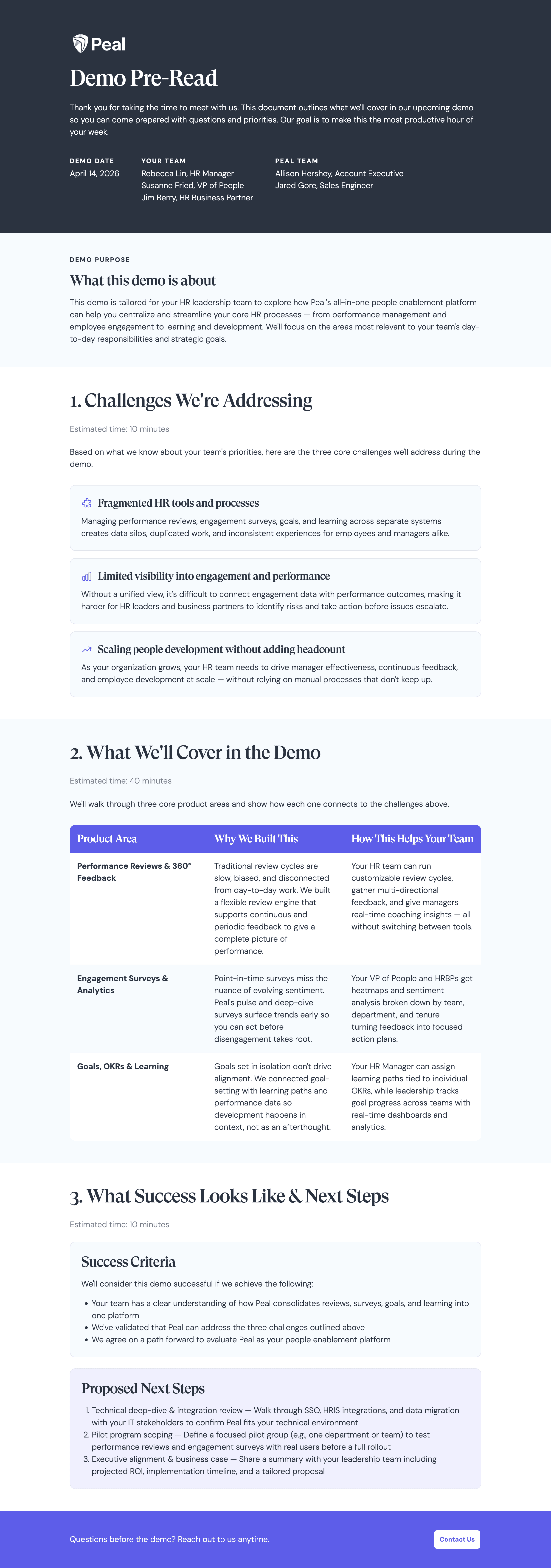
A demo pre-read is a page sent before a demo that maps the prospect’s challenges to what you will show, sets success criteria, and outlines what happens next. The strongest pre-reads make every attendee arrive knowing what they are evaluating and why it matters to them.
What Mutiny’s demo pre-read blueprint creates
Mutiny’s demo pre-read blueprint builds a preparation page with these parts:
Demo details. Date, time, and attendees from both sides, so everyone knows who is in the room and why.
Demo framing. A clear statement of what the demo is designed to accomplish, including the inputs and assumptions shaping what you will show.
Challenges section. Three cards covering the specific problems the prospect shared in discovery, written to resonate with the attendees in the room.
Product coverage table. The product areas you will show, mapped to the challenges they address, with time allocations that set expectations.
Numbered agenda. The running order with clear time blocks, organized around Challenges We’re Addressing, What We’ll Cover, and What Success Looks Like.
Success criteria. A clear definition of a successful demo, grounded in the challenges the prospect actually shared.
Proposed next steps. What happens after the demo, derived from the success criteria so the path forward is clear before the call ends.
That structure doubles as a template for what a strong demo pre-read should contain, whether you build it in Mutiny or by hand.
Why does a demo pre-read work?
A demo pre-read works because the preparation before the call sets up the outcome. When attendees arrive knowing what they are evaluating and why it matters to their role, the demo skips the context-setting and goes straight to what moves the deal.
The evidence is strong: AmpUp’s analysis found high-preparation sales interactions correlated with a 6.8x higher stage-progression rate than low-preparation ones, the largest differential among the behaviors studied. Sellers agree: in Crystal Knows’ 2024 Meeting Prep Survey, 92% said pre-meeting research significantly impacts their success rate.
When should you use a demo pre-read?
Use a demo pre-read when a demo needs everyone aligned before it starts. Three situations call for one:
Multi-stakeholder demos. A VP, a champion, and an ops lead each need to understand why they are there. A pre-read gives each attendee the context relevant to their role.
Complex product demos. Framing which areas you will cover and why keeps the demo focused and prevents it from drifting into features that do not matter to this buyer.
Competitive evaluations. A pre-read that connects your product to the prospect’s stated challenges positions you before the demo begins.
How to create a demo pre-read, step by step
Creating a pre-read means turning discovery into a shared plan for the demo. Work through it in this order:
Start from discovery, your notes or the call transcript.
Name the attendees and why each one is in the room.
Map their challenges to the product areas you will show.
Set time expectations with a clear, numbered agenda.
Define success and next steps before the call begins.
Mutiny compresses this into minutes. Share your transcript or discovery notes, and it builds the full page: challenges, product coverage, agenda, success criteria, and next steps. The more context you provide, the sharper the output.
What makes a great demo pre-read?
Map challenges to what you will show.
Give each attendee a reason to be in the room.
Set time expectations up front.
Define success before the call.
Make next steps clear in advance.
A cold-start demo vs. a demo with a pre-read
A cold-start demo spends its first stretch re-establishing context. A demo with a pre-read starts warmed up and stays focused:
Dimension | Cold-start demo | Demo with a pre-read |
|---|---|---|
First 20 minutes | Re-establishing context | Straight into what matters |
Attendees | Unsure why they are there | Clear on their stake |
Focus | Drifts into irrelevant features | Anchored to their challenges |
Success criteria | Undefined | Agreed before the call |
Next steps | Figured out after | Clear before it ends |
The fastest way to build a demo pre-read: Mutiny
Mutiny is the GTM agent built for customer-facing work and workflow automation. The agent builds the full pre-read from your discovery transcript, and teams wire it into a repeatable routine so every scheduled demo goes out with one attached. It is built for account executives running tighter demos and the sales leaders who want demo quality to be repeatable across the team.
Teams using Mutiny create assets 4.5x faster with 100% design satisfaction, so a pre-read goes out the day before every demo without adding prep time.
“We’ve always invested heavily in personalized content for our enterprise accounts, but we can’t do that for every deal. Mutiny lets our commercial reps create that same caliber of content on their own. Our sales team was genuinely shocked at the quality. Turning call transcripts into something slick and deal-ready is a huge unlock for our reps.”
Hillary Carpio, VP of Marketing, Snowflake
Use this blueprint to build a demo pre-read for your next demo in minutes.
Related blueprints
Explore the rest of the blueprint library: the Deal Room, Meeting Recap, Group Demo Follow-Up, and Pitch Deck blueprints carry the demo through the rest of the deal.
Last updated: July 15, 2026
Frequently asked questions
What is a demo pre-read?
A demo pre-read is a page sent before a demo that maps the prospect’s challenges to what you will show, sets the agenda and success criteria, and outlines next steps. It gives every attendee the context to arrive prepared, so the demo starts warmed up instead of spending its first stretch re-establishing what discovery already covered.
Why should you send a pre-read before a demo?
Because preparation drives the outcome. When attendees know what they are evaluating and why it matters to their role, the demo goes deeper faster. Highly prepared sales interactions progress deals at several times the rate of unprepared ones, and a pre-read is how you bring that preparation to both sides of the call.
What should a demo pre-read include?
A strong demo pre-read includes the demo details and attendees, a framing of what the demo will accomplish, the prospect’s key challenges from discovery, a product coverage table mapping those challenges to what you will show, a numbered agenda with time blocks, clear success criteria, and proposed next steps.
How is a pre-read different from a meeting agenda?
An agenda lists what will happen. A pre-read connects the demo to the prospect’s specific challenges, sets success criteria, and gives each attendee a reason to engage. It does the work of a seasoned sales engineer: aligning expectations and framing the conversation before anyone joins the call.
How do you build a demo pre-read quickly?
With Mutiny, you share your discovery notes or transcript, and the agent builds the full page: challenges, product coverage, agenda, success criteria, and next steps. That turns demo prep into a few minutes of review instead of a manual build, and makes a tailored pre-read realistic for every demo.
How much does Mutiny cost?
Mutiny offers Free, Business, and Enterprise custom plans (starting at $30k). Reps can start building demo pre-reads on the Free plan, and larger teams move to Business or Enterprise for scale, controls, and support. See the pricing page for current details.
Demo Pre-read
A pre-demo page that sets the agenda, connects your product to the prospect's challenges, and gives every attendee a reason to show up prepared.
When to use this blueprint
You have a demo scheduled with multiple stakeholders and want everyone aligned on what they're evaluating before they walk in
Your demos are running long because the first 20 minutes are spent establishing context that could have been shared in advance
You want to signal to the prospect that this demo was built for them, not pulled from a standard library