An executive business case is a concise document that makes the argument for a purchase to the person who controls the budget. It frames the strategic problem, recommends an approach, quantifies the target outcomes, and ends with a direct ask for approval, so a champion can carry the decision into an internal meeting you will not attend.
What Mutiny’s executive business case blueprint creates
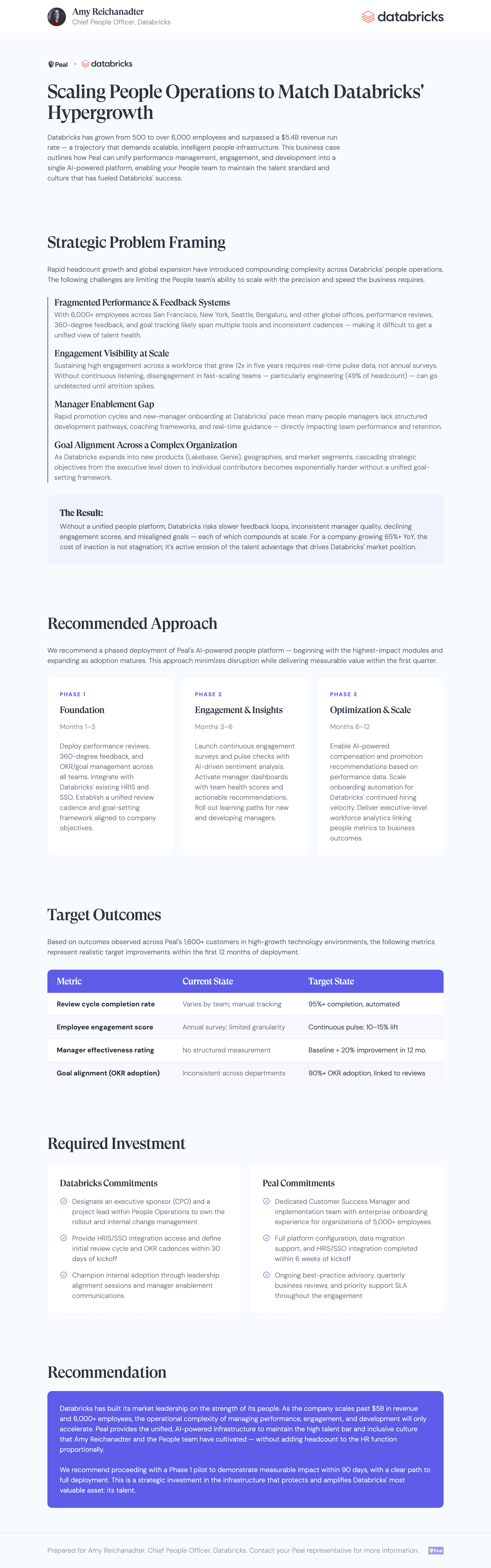
Mutiny’s executive business case blueprint builds an elevated business document with the components an approver expects:
Executive navigation bar. The rep’s name and title with the prospect’s logo, signaling a prepared, professional document.
Executive summary. A one-line headline plus a paragraph that gives the approver full context up front.
Strategic problem framing. The problems, the urgency, and the cost of inaction, in the approver’s language.
Recommended approach. How implementation unfolds across phases, structured to feel clear and manageable.
Target outcomes table. Current state and target state side by side across three to four key metrics, making ROI visible before anyone asks.
Required investment. What the prospect commits to and what you commit to, side by side.
Final recommendation. A direct summary and a clear ask for approval, written for an executive who reads the bottom line first.
That structure doubles as a template for what a strong business case should contain, whether you build it in Mutiny or by hand.
Why do business cases decide enterprise deals?
Business cases decide enterprise deals because the person who signs often never joined the evaluation calls. A document built for that approver gives your champion the argument, the framing, and the numbers to justify the investment internally, which keeps a bought-in deal from stalling at the approval stage.
Buying groups are large and largely out of reach: Forrester’s State of Business Buying, 2026 finds the typical decision now includes 13 internal stakeholders and 9 external influencers. Approvers also want fast payback: 57% of B2B buyers expect ROI within three months of a software purchase, per Corporate Visions, which is why quantifying target outcomes matters so much.
When should you use an executive business case?
Use an executive business case when the decision moves above your champion to someone who was not in the room. Three moments call for one:
C-suite approval required. When the signer wasn’t in the evaluation calls, a document that makes the case from the beginning gets to yes faster than anything the champion assembles alone.
Large or multi-year investments. The bigger the number, the more structured the justification finance needs, including the cost of inaction alongside target outcomes.
Competitive final decisions. When an executive is choosing between vendors, the cleaner, more structured business case signals the operational maturity enterprise buyers evaluate.
How to write an executive business case, step by step
Writing a business case means turning your champion’s conviction into an argument an approver can act on. Build it in this order:
Name the approver and write for their priorities.
Open with an executive summary that states the case in one line.
Frame the strategic problem and the cost of inaction first.
Recommend an approach structured in clear phases.
Quantify target outcomes with a current-state versus target-state table.
Lay out the required investment on both sides.
Close with a direct recommendation and a clear ask for approval.
Mutiny compresses this into minutes. Describe the approver and share your champion context (call transcripts, notes, or a summary), and the agent builds the full page from that input. The more specific the metrics and problems you provide, the stronger the case.
What makes a strong executive business case?
Write for the approver who holds the budget, so the argument lands with the person who signs.
Lead with the cost of inaction, then the target outcomes.
Make ROI visible with a clear current-state versus target-state table.
Keep it tight and readable for an executive who starts at the bottom line.
End with one clear ask for approval.
An executive business case vs. a standard sales one-pager
A standard one-pager sells features to an evaluator. An executive business case makes a financial argument to an approver:
Dimension | Standard sales one-pager | Executive business case |
|---|---|---|
Audience | The evaluator on the calls | The approver who controls budget |
Opening | Product and features | Strategic problem and cost of inaction |
Proof | Feature list | Quantified target outcomes and ROI |
Ask | Book a demo | Approve the investment |
Who reads it | The champion | The VP or CFO the champion presents to |
The fastest way to build an executive business case: Mutiny
Mutiny is the GTM agent built for customer-facing work and workflow automation. The agent builds the full business case from your champion context and the metrics that came up in the deal, and teams turn it into a repeatable routine so every enterprise opportunity gets an approver-ready document. It is built for account executives and the sales leaders who want a repeatable way to turn champion conviction into approved budget.
Teams using Mutiny create assets 4.5x faster with 100% design satisfaction, so your champion walks into the approval meeting prepared.
“Partnering with Mutiny has been transformational for our marketing team. Their AI platform powers everything from account research to dynamic personalization and sales alignment.”
Martyn Etherington, Chief Marketing Officer, BMC
Use this blueprint to build an executive-ready business case for your next enterprise deal in minutes.
Frequently asked questions
How much does Mutiny cost?
Mutiny offers Free, Business, and Enterprise custom plans (starting at $30k). Reps can start building business cases on the Free plan, and larger teams move to Business or Enterprise for scale, controls, and support. See the pricing page for current details.
Related blueprints
Explore the rest of the blueprint library: the Deal Room, Pricing Proposal, Pitch Deck, and Impact Report blueprints pair naturally with an executive business case.
Frequently asked questions
What is an executive business case?
An executive business case is a concise document that makes the argument for a purchase to the person who controls the budget. It frames the strategic problem, recommends an approach, quantifies target outcomes, and ends with a direct ask for approval, so a champion can present it internally.
What should an executive business case include?
A strong business case includes an executive summary, strategic problem framing with the cost of inaction, a phased recommended approach, a target outcomes table showing current versus target state, the required investment on both sides, and a final recommendation with a clear ask for approval.
How is a business case different from a proposal?
A proposal focuses on scope, terms, and pricing for the buyer you are already working with. A business case makes the strategic and financial argument for why the purchase should happen at all, written for an approver who needs justification before signing off on the investment.
When should you create an executive business case?
Create one when the decision rises above your champion to a VP or CFO who wasn’t part of the evaluation, when the investment is large or multi-year, or when a deal has stalled at the approval stage because the economic buyer lacks a clear justification for the spend.
How do you quantify ROI in a business case?
Show the current state and target state side by side across three or four key metrics, include the cost of inaction, and tie the numbers to a payback period. Use metrics that came up in your conversations with the champion so the figures reflect the buyer’s own situation.
How do you build a business case quickly?
With Mutiny, a rep describes the approver and shares champion context like call notes or a summary, and the agent builds the full executive business case in minutes. That gives every enterprise deal an approver-ready document without assembling it by hand.
Executive Business Case
An executive-ready business case your champion can share internally so you can win the room you're not in.
When to use this blueprint
Your champion is bought in but needs to bring the decision to a VP or CFO who wasn't part of the evaluation
A deal is stalled at the approval stage because the executive sponsor doesn't have a clear reason that justifies the investment
You want to give your champion something that makes the internal case as well as you would in person