A forward-looking strategy review is a page that frames a customer’s next chapter: where they are versus where they need to be, the workflows that close the gap, and a dated plan with owners on both sides. The strongest reviews spend most of their space on what comes next and anchor the expansion conversation in a concrete plan.
What Mutiny’s forward-looking strategy blueprint creates
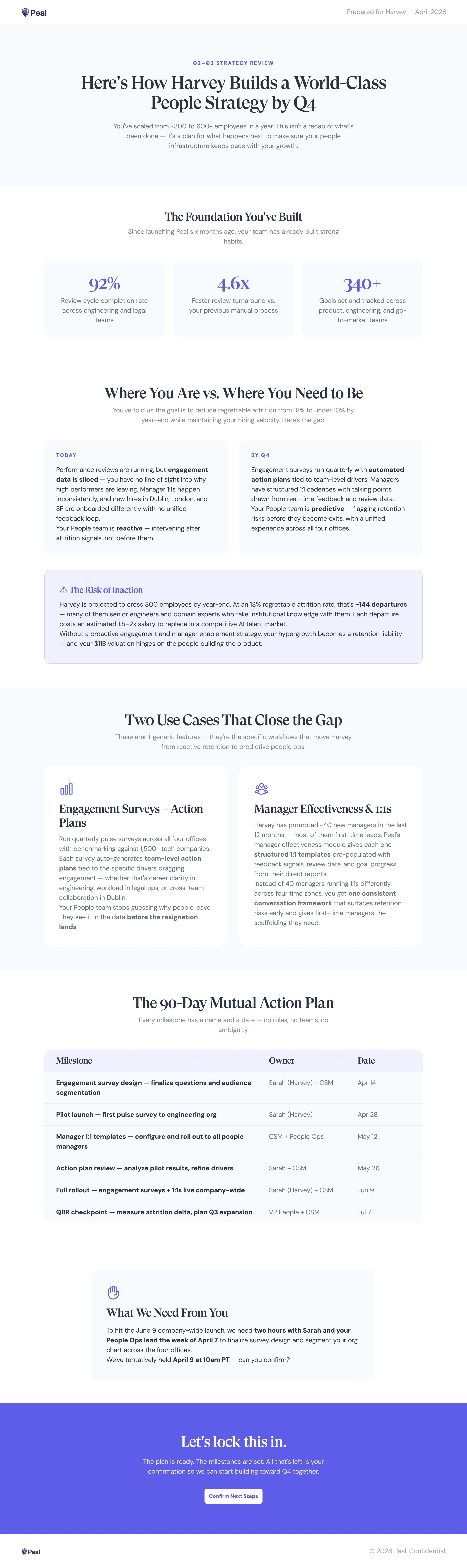
Mutiny’s forward-looking strategy blueprint builds a strategic review page with these parts:
Goal-specific hero. A headline that names the customer and references their stated goal directly.
ROI snapshot. Two to three bold stats that validate what is working and earn the right to talk about the future.
Gap analysis. Where the customer is today versus where they have said they need to be, with a risk-of-inaction callout naming what happens if the gap stays open.
Use case cards. The one or two workflows that close the gap, each tied to this customer’s situation.
90-day outlook. A clean table of milestones, owners, and dates on both sides, every row with a real name and a real date.
Resource ask. A direct, specific ask for what you need from the customer to hit the 90-day outcome.
That structure doubles as a template for what a strong strategy review should contain, whether you build it in Mutiny or by hand.
Why does a forward-looking strategy review drive expansion?
A forward-looking review drives expansion because it gives the customer a concrete plan to react to, so the conversation shifts from reviewing the past quarter to deciding the next one. Naming the gap and the workflows that close it gives an expansion ask something specific to stand on.
The mutual-commitment structure is what moves deals: Outreach’s data across thousands of deals shows deals where sellers align buyers around a mutual action plan see a 26% higher win rate than those without. The joint plan compounds: Salesforce reports that a shared, standardized action plan speeds up the sales cycle and can lift revenue 10-15% by improving the customer experience.
When should you use a forward-looking strategy review?
Use a forward-looking review whenever the next chapter matters more than the last one. Three moments call for one:
Quarterly business reviews. Arrive with a plan for the next quarter so the meeting is spent making decisions.
Expansion conversations. Name the exact workflows that would close the customer’s gap to anchor the conversation.
Renewal positioning. Start 90 days before the contract is up to show you are invested in the outcome.
How to build a forward-looking strategy review, step by step
Building a strategy review means proving what works, then pointing at the gap and the plan to close it. Work through it in this order:
Name the customer’s goal in the hero.
Validate what is working with a short ROI snapshot.
Lay out the gap between today and their stated target, with the risk of inaction.
Recommend the workflows that close it.
Lock a 90-day plan with owners and dates on both sides, plus a clear resource ask.
Mutiny compresses this into minutes. Describe the account and where things stand, and it builds the gap analysis, the 90-day plan, the use-case recommendations, and the mutual commitments. The more specific you are, the sharper the output.
What makes a great strategy review?
Spend most of the page on what is next.
Quantify the gap and the risk of leaving it open.
Tie recommended workflows to this customer.
Put owners and dates on both sides.
Make a direct resource ask.
A backward-looking QBR vs. a forward-looking review
A backward QBR recaps adoption and usage. A forward-looking review frames the next chapter and secures commitment to it:
Dimension | Backward QBR | Forward-looking review |
|---|---|---|
Focus | The past quarter | The next 90 days |
Data | Adoption and usage | Gap to the stated goal |
Outcome | A recap | A committed plan |
Expansion | Implied | Anchored to specific workflows |
Accountability | None | Owners and dates on both sides |
The fastest way to build a strategy review: Mutiny
Mutiny is the GTM agent built for customer-facing work and workflow automation. The agent builds the full strategy review from your account context, and teams turn it into a repeatable routine so every account gets a forward-looking QBR each quarter. It is built for the customer success and account teams inside the sales organizations that own retention and expansion.
Teams using Mutiny create assets 4.5x faster with 100% design satisfaction, so a strategic review is ready for every account, every quarter.
“With the template library, I can spin up personalized assets in minutes. Being able to give people what they need at the right moment, that’s a huge differentiator right now.”
Kevin Jong, Principal GTM AI Operator, Genesis Computing
Use this blueprint to build a forward-looking strategy review for your next QBR in minutes.
Related blueprints
Explore the rest of the blueprint library: the Impact Report, Expansion ABM Page, Executive Business Case, and Deal Room blueprints work alongside a strategy review across the customer lifecycle.
Last updated: July 15, 2026
Frequently asked questions
What is a forward-looking strategy review?
A forward-looking strategy review is a page that frames a customer’s next chapter: where they are today versus where they said they need to be, the workflows that close that gap, and a 90-day plan with owners and dates on both sides. It is built to turn a QBR into a decision-making conversation and to anchor expansion in a concrete plan.
How is it different from a standard QBR?
A standard QBR spends most of its time recapping adoption and usage the customer already knows. A forward-looking review spends most of its space on the next 90 days: the gap to the stated goal, the workflows that close it, and a committed plan. The customer arrives ready to make decisions instead of sitting through a status update.
What should a forward-looking strategy review include?
A strong review includes a goal-specific hero, a short ROI snapshot that validates what is working, a gap analysis with a risk-of-inaction callout, one or two recommended workflows that close the gap, a 90-day outlook with owners and dates on both sides, and a direct resource ask.
Why does a strategy review help drive expansion?
Because it gives the customer a concrete plan to react to and names the specific workflows that would close their gap. That anchors the expansion conversation in the customer’s own goals. A shared, dated plan with commitments on both sides also correlates with materially higher win rates than deals run without one.
How do you build a strategy review quickly?
With Mutiny, you describe the account and where things stand, and the agent builds the full page: gap analysis, 90-day plan, use-case recommendations, and mutual commitments. That gives every account a forward-looking QBR each quarter without a CSM starting from a blank page.
How much does Mutiny cost?
Mutiny offers Free, Business, and Enterprise custom plans (starting at $30k). Teams can start building strategy reviews on the Free plan, and larger teams move to Business or Enterprise for scale, controls, and support. See the pricing page for current details.
Forward Looking Strategy
A strategic review page that is built to drive expansion conversations and secure mutual commitment.
When to use this blueprint
You're heading into a QBR and want to arrive with a clear point of view on what's next, not a usage recap
You're trying to drive an expansion conversation and need something more compelling than a feature announcement
A customer has outgrown their original goals and needs a new horizon to work toward