
Challenge
Making a startup look like the most credible partner in a competitive enterprise evaluation
Paige Wunderlich has spent nearly a decade in B2B enterprise sales, including the last year and a half at Atomicwork, where she carries strategic enterprise accounts. As Atomicwork moved upmarket, her deals became more complex: more stakeholders, executives entering late in the process, complicated pricing, and buying committees evaluating the company as closely as the product.
Her job, functionally, was to make a startup look like the most credible partner in a competitive enterprise evaluation. No small task for a scale-up business competing with large enterprise incumbents.
Every deck cost two to three hours, even with a template in place
“I was the queen of Canva,” Paige said. A standard pre-demo deck or point-of-view deck ran two to three hours of manual work, even when starting from an existing template. Entire afternoons disappeared into it.
“I put together a personalized deck in five minutes yesterday in Mutiny. And it was beautiful. This used to take me 3–5 hours.” — Paige Wunderlich, Enterprise Account Executive at Atomicwork
Her efficiency, not her pipeline, capped her book
The math was simple: if each opportunity required hours of asset production, there was a hard ceiling on how many deals Paige could actively work. “My efficiency didn’t allow me to scale my business,” she said. “I had to focus on five deals at a time. And that was all I could do.”
Paige couldn’t deliver the best possible buyer experience with current tools
Because the production cost was so high, what actually reached buyers was thinner than what Paige knew. She was presenting broad themes rather than her cohesive, account-specific point of view. As she put it, she wasn’t giving prospects “the amount of love and attention that they do now.”
All the context existed; it just lived in five places
Call recordings in Granola and Fathom, threads in Slack, email in Outlook, and notes from prior calls all held useful information. Paige’s challenge was turning that disparate context into something a buying committee would actually read. This consistently cost her an entire afternoon.
Solution
On-brand assets built by the seller, rooted in each deal’s unique context
Paige built a two-step workflow that runs daily. First, she uses Claude’s MCP connections to pull context across Slack, Granola, Fathom, and Outlook into a holistic view of the deal. Then she hands that context to Mutiny, which turns it into a fully branded, prospect-ready deck in minutes.
This combination lets her deploy Mutiny across multiple points in an enterprise deal.
Discovery meeting prep and deck creation
Atomicwork gets a sizable number of founder-sourced opportunities with minimal context attached. Paige needs to walk into those calls with a well-researched point of view and a tailored deck to run proper discovery. As any seasoned enterprise seller knows, first impressions matter. She uses Mutiny to create hyper-personalized decks that deliver a stronger buyer experience from the first touch.
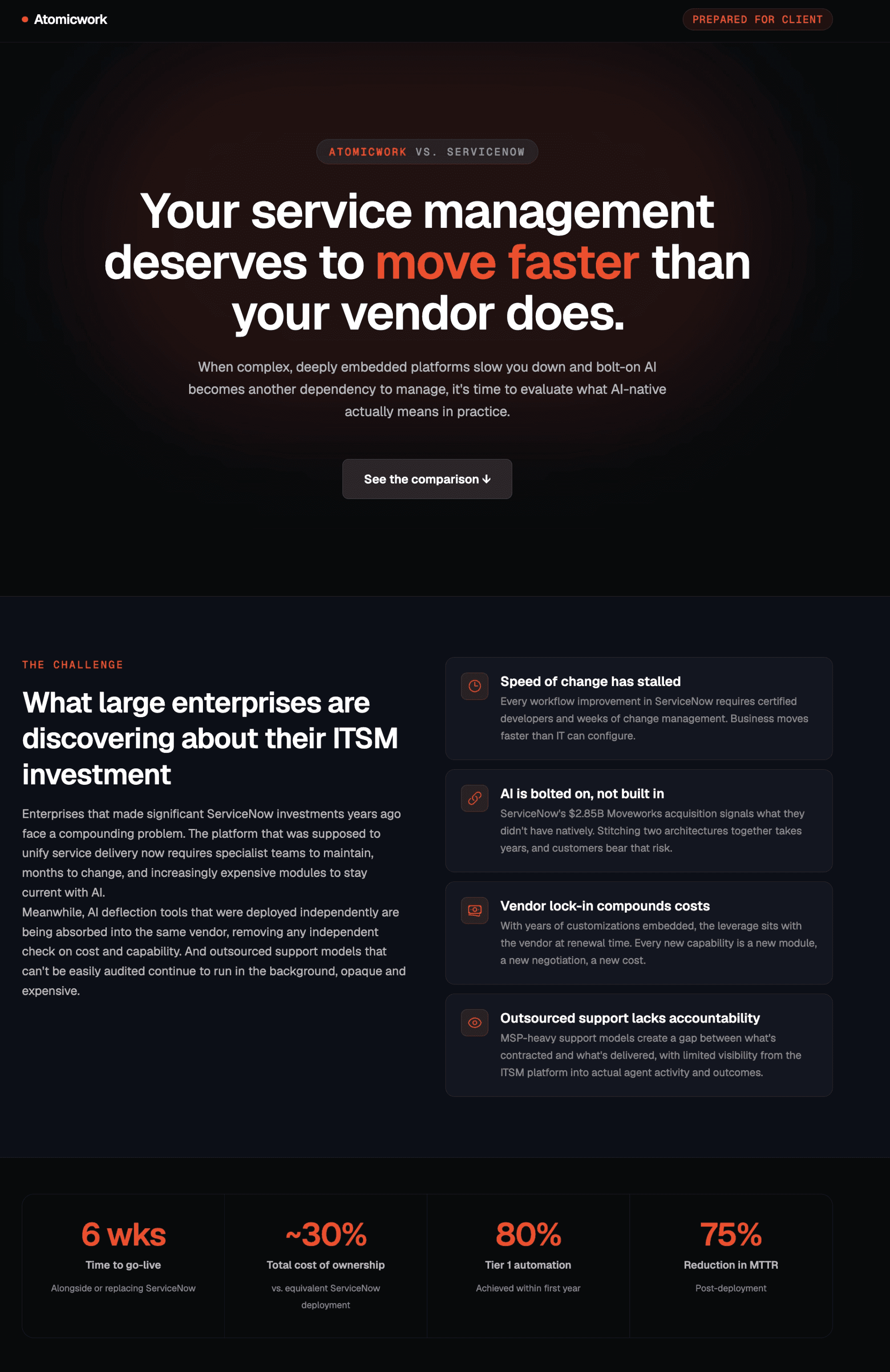
Vendor analysis asset
Before Mutiny: 2 hours
With Mutiny: 5–10 minutes
Late-stage executive alignment
When an executive appears in month three of an evaluation and asks who everyone is, Paige sends a single Mutiny page that outlines everything done to date, every use case tested, the point of view, and every stakeholder involved. “It allows them to quickly click through and see the work that went into the project and evaluation,” she said.
Internal executive briefs
When Paige pulls product leaders or her own executives into a deal, she builds them a Mutiny brief so they can quickly get up to speed. One brief for a particularly large deal became the reference document the whole internal team keeps returning to.
“This has been our north star internally for this deal. People keep coming back to it to get updates as the deal progresses.”
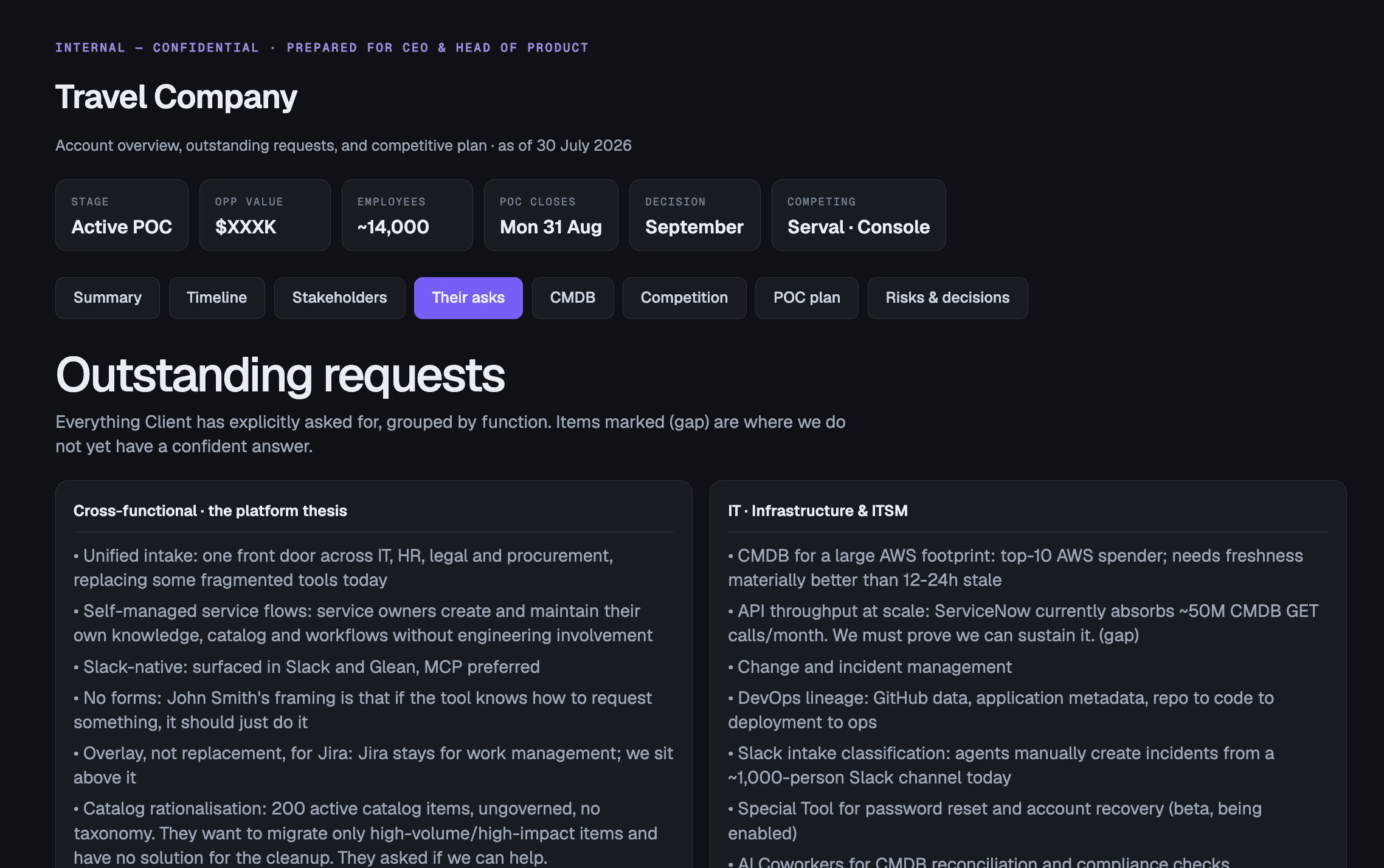
Internal deal status brief
Impact: 22 unique internal visitors, acting as the source of truth.
Before Mutiny: 5+ hours
With Mutiny: 20 minutes
Pricing proposals and pricing guides
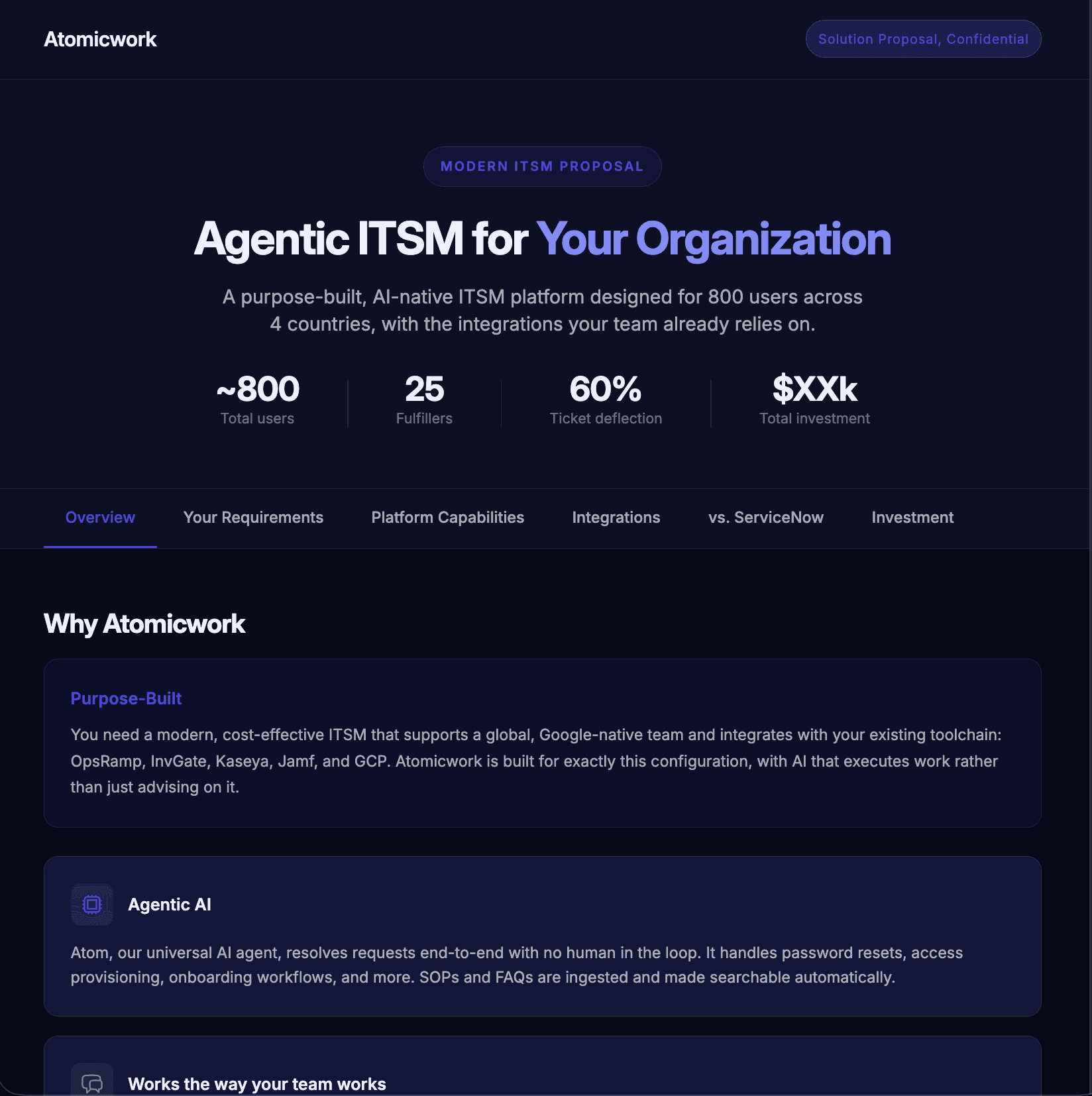
Atomicwork’s pricing is complicated, and the sales team had trouble presenting it in an understandable way for prospects. Paige built a multi-option pricing proposal with a summary up top, an explanation of each option, and an ROI story to help close the deal. The company circulated it heavily among executives, and it is now Paige’s standard way to present pricing in her deals.
ITSM proposal
30+ views and more than an hour of engaged time.
Before Mutiny: 1 hour
With Mutiny: 5 minutes
Outcome
Multiple closed enterprise deals, a book she can scale, and a startup that stops looking like one
Paige can now handle a larger book because of the time she saves with Mutiny. What took two to three hours in Canva now takes five minutes. The afternoon Paige used to spend building decks for the next day’s meetings is now spent with prospects.
That extra capacity changed the number of deals Paige can pursue at once. Where her ceiling once held her to roughly five middle-of-the-road active deals, she can now run multiple strategic-level deals in addition to what she could do in the past.
Paige now walks into every deal looking like the most polished rep in the evaluation. In deals where Atomicwork competes against larger incumbents, she is able to deliver a better experience than reps with enterprise marketing teams behind them.
Every deck and proposal sheet comes out on-brand, which Paige contrasts directly against generic AI output: presentations in Claude can take enormous effort to create and still feel off-brand when they are done.
“I absolutely love Mutiny. I will continue to sing its praises, just not to our competition.” — Paige Wunderlich, Enterprise Account Executive at Atomicwork