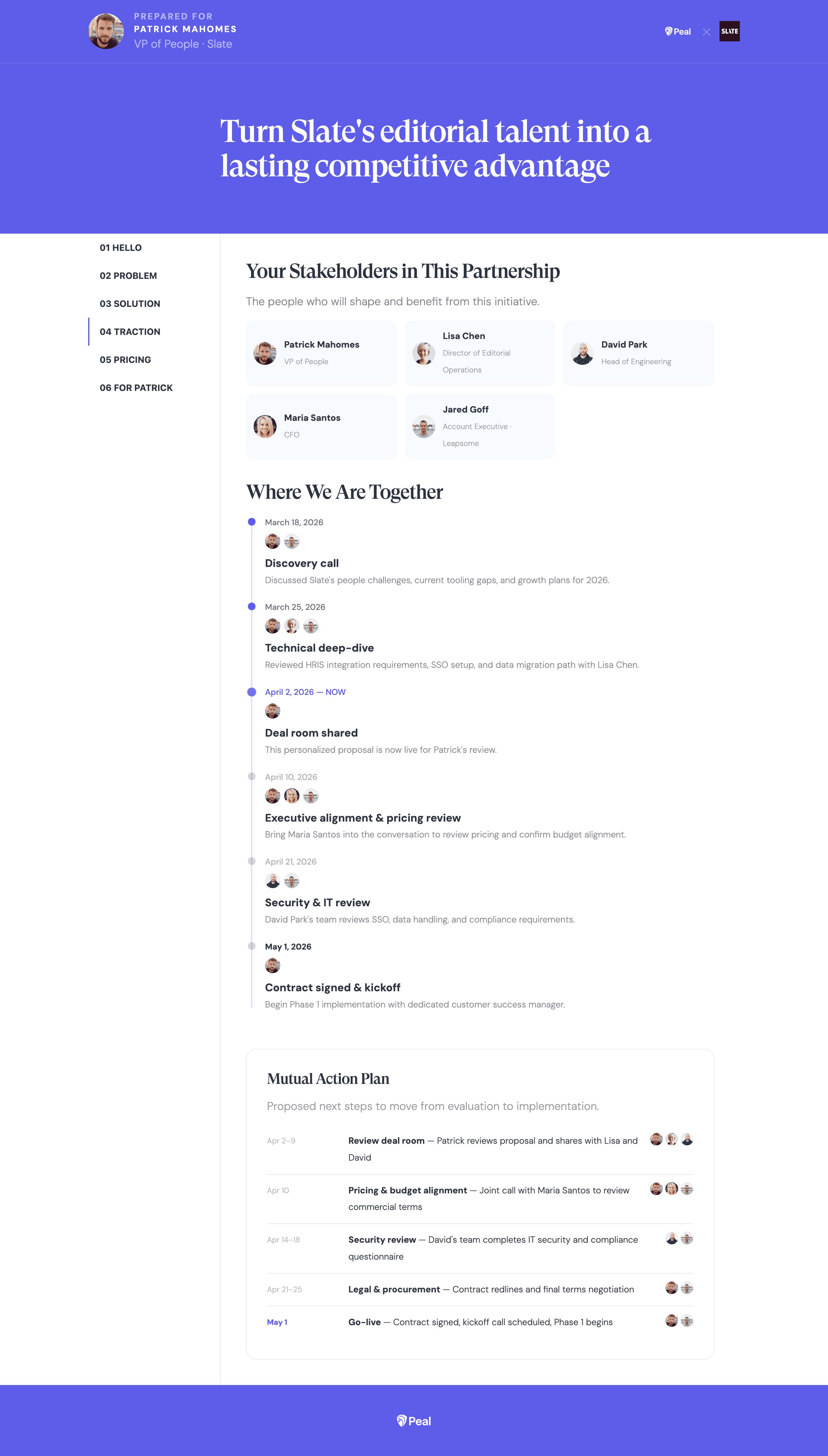
A deal room, also called a digital sales room, is a single online space that holds everything relevant to one opportunity: the deal overview, key contacts, shared resources, and a mutual action plan. It keeps every stakeholder aligned so a new decision-maker can get up to speed without restarting the deal.
What Mutiny’s deal room blueprint creates
Mutiny’s deal room blueprint assembles a branded, shareable space with the components that keep a deal moving:
Co-branded header. Your logo and the prospect’s side by side, setting a partnership tone from the first second.
Deal overview. A clear summary of where the deal stands and the path to a decision, written for a new stakeholder who needs context fast.
Key contacts. Everyone on both sides with name, title, and role in the evaluation.
Shared resources. Every relevant asset in one place: the demo recording, case studies, business case, and pricing proposal, organized by type.
Mutual action plan. A shared timeline with milestones, owners, and dates, so both sides know what happens next and who owns it.
Next steps. The immediate actions each side has committed to, specific and time-bound.
Call to action. A direct, always-visible link to book time with the rep.
That structure doubles as a checklist for what a great deal room should contain, whether you build it in Mutiny or by hand.
Why do deal rooms help close deals?
Deal rooms help close deals by giving every stakeholder one place to see where things stand, which keeps alignment from depending on a single champion forwarding the right email. When the buying committee can self-serve context, deals move faster and survive new people joining late in the cycle.
According to Mindtickle’s 2025 State of Revenue Enablement Report, deals with an associated digital sales room show a 26% higher win rate, close 30% bigger, and shorten sales cycles by 10%. Engagement inside the room is itself a signal: SalesHood’s analysis of nearly $1 billion in influenced pipeline and 50,000 digital sales rooms found that high-performing rooms averaged 16 repeat buyer visits.
When should you use a deal room?
Use a deal room whenever a deal has more than one stakeholder or more than a few weeks of runway. Four situations benefit most:
Multi-stakeholder enterprise deals. When five people across three departments are involved, a room gives each a place to find what they need without emailing your champion.
Competitive evaluations. A more organized, buyer-specific room signals how you operate, and process quality becomes part of the evaluation.
Long sales cycles. A room that stays current means no conversation restarts from scratch.
Post-demo follow-up. A room sent within hours of a strong call gives momentum a place to live and something for your champion to share.
How to build a deal room, step by step
Building a deal room means turning scattered deal context into one clear, shareable destination. Assemble it in this order:
Co-brand the room with both logos.
Write a deal overview aimed at a stakeholder who just joined.
Map key contacts on both sides with roles.
Gather shared resources into one organized place.
Build a mutual action plan with milestones, owners, and dates.
Spell out next steps that are specific and time-bound.
Add a clear call to action to book the next conversation.
Mutiny compresses this into minutes. Drop in your call transcripts, meeting notes, or a quick summary, and the agent builds the deal overview, organizes the resources, maps the mutual action plan, and sets up next steps from that context. You share it with your champion and watch the engagement analytics.
What makes a great deal room?
Write for the newest stakeholder, so anyone looped in late gets oriented fast.
Keep the mutual action plan current, since it is the single source of truth for the deal.
Put the right proof where each persona looks: business cases for finance, security docs for technical reviewers.
Send it within hours of a strong call to capture momentum.
Track engagement and act on repeat visits, the clearest buying signal a room gives you.
Deal room vs. email, drives, and Slack threads
Most deals are run across email chains, shared drives, and Slack threads that only the original champion can navigate. A deal room replaces that sprawl with one destination every stakeholder can use:
Dimension | Email, drives, and Slack | Deal room |
|---|---|---|
Where the deal lives | Scattered across tools | One shared destination |
New stakeholder onboarding | Starts from scratch | Gets full context immediately |
Who can navigate it | Only the champion | Every stakeholder on both sides |
Resources | Buried in attachments | Organized in one place |
Momentum after a call | Fades in the inbox | Has a place to live and be shared |
Visibility | None | Engagement analytics per stakeholder |
The fastest way to build a deal room: Mutiny
Mutiny is the GTM agent built for customer-facing work and workflow automation. The agent builds the full deal room from your call notes and CRM context, and reps turn the follow-through into repeatable routines so every open opportunity looks as organized as their best deal. It is built for account executives and the sales leaders who want a consistent deal experience across the pipeline.
Teams using Mutiny create assets 4.5x faster with 100% design satisfaction, so a room ships in minutes and stays current through the cycle.
“My champion said nobody gave her anything like what I gave her. This makes it so much easier for me to show them everything that we’ve walked through and done.”
Jeff Goldberg, Account Executive, Kaizen
Use this blueprint to build a branded deal room for your next opportunity in minutes.
Frequently asked questions
How much does Mutiny cost?
Mutiny offers Free, Business, and Enterprise custom plans (starting at $30k). Reps can start building deal rooms on the Free plan, and larger teams move to Business or Enterprise for scale, controls, and support. See the pricing page for current details.
Related blueprints
Explore the rest of the blueprint library: the Pitch Deck, Executive Business Case, Pricing Proposal, and Meeting Recap blueprints all feed naturally into a deal room.
Frequently asked questions
What is a deal room?
A deal room is a single online space that holds everything relevant to one opportunity: a deal overview, key contacts, shared resources, a mutual action plan, and next steps. It keeps the whole buying committee aligned and lets a new stakeholder get up to speed without restarting the deal.
Is a deal room the same as a digital sales room?
Yes. Deal room and digital sales room describe the same thing: a shared, branded space for one opportunity where buyers and sellers track progress and access resources. Some teams also call it a buyer microsite. The purpose is the same across all three names.
What should a deal room include?
A strong deal room includes a co-branded header, a deal overview written for new stakeholders, key contacts on both sides, shared resources organized by type, a mutual action plan with owners and dates, clear next steps, and a visible call to action to book the next conversation.
When should you use a deal room?
Use a deal room for multi-stakeholder deals, competitive evaluations, long sales cycles, and post-demo follow-up. Any time alignment would otherwise depend on your champion forwarding the right email, a room keeps everyone on the same page and the deal moving.
How do you build a deal room quickly?
With Mutiny, a rep drops in call transcripts, notes, or a short summary, and the agent builds the deal overview, organizes resources, maps the mutual action plan, and sets up next steps automatically. A branded room is ready to share in minutes rather than assembled by hand.
How do you measure a deal room?
Track stakeholder engagement: who visited, how often, and which resources they opened. Repeat visits are a strong buying signal. Then connect that engagement to deal outcomes like stage conversion, sales cycle length, mutual action plan completion, and win rate.
Deal Room
A collaborative, branded deal room that gives buyers and sellers a shared space to track progress, share resources, and keep every stakeholder aligned from first meeting.
When to use this blueprint
You have multiple stakeholders in a deal and need one place to keep everyone on the same page
Your champion needs something they can share internally to build the case without your help
You want every open opportunity to look as organized and intentional as your best deals do