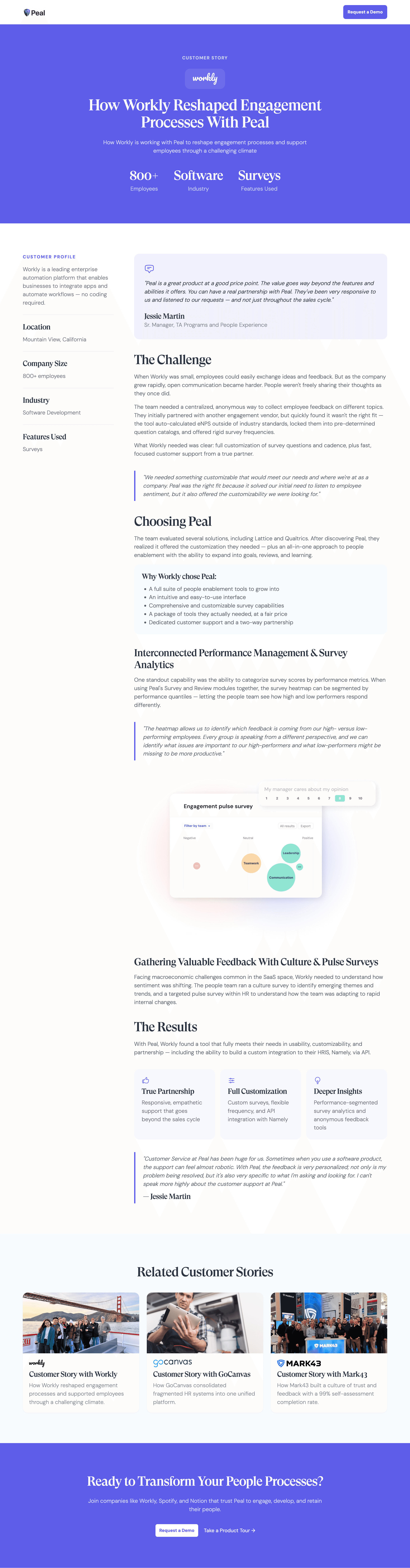
A B2B case study is a customer success story structured as problem, solution, and results, built to help a similar buyer picture the same outcome. The strongest case studies lead with the result, show the “like me” signal early, back it with real metrics and quotes, and point the reader to a clear next step.
What Mutiny’s case study blueprint creates
Mutiny’s case study blueprint turns a customer win into a polished, skimmable story page with these parts:
Bold hero. The customer logo and key stats up front, with a headline that states the outcome before the reader goes looking.
Sticky summary sidebar. A left-anchored summary that stays visible as the reader scrolls, giving skimmers the gist and pulling deeper readers into the narrative.
Editorial content. Problem, solution, and results told like a story, with key quotes pulled out and key metrics called out visually.
Related resources. Additional case studies or assets that keep the reader moving through their evaluation.
That structure doubles as a template for what a strong case study should contain, whether you build it in Mutiny or by hand.
Why do case studies influence B2B buyers?
Case studies influence buyers because they reduce perceived risk: seeing a company like theirs achieve the outcome makes the decision feel safe. A well-built case study surfaces that “like me” signal early and gives the buying committee proof they can forward internally.
Buyers rank them at the top: in the Mixology AI B2B Buyer Report, 42% of B2B buyers said case studies and success stories are the most influential type of content. Helpful proof pays off in deal quality too. Gartner found that buyers who see supplier content as helpful are 2.8x more likely to experience high purchase ease and 3x more likely to buy a bigger deal with less regret.
When should you use a case study?
Use a case study whenever proof from a similar customer would move a buyer forward. Three situations stand out:
Active deal support. When a prospect asks whether you have worked with anyone in their industry, a page with a bold hero, real metrics, and a direct CTA does more than a PDF attachment.
Website social proof. A library of case study pages gives every visitor a reason to believe you can do for them what you did for someone else, and each page compounds as an SEO asset.
Outbound and ABM personalization. Drop a matching case study into cold outreach, a deal room, or a meeting recap, and it does more selling than any feature list.
How to write a B2B case study, step by step
Writing a case study means turning a customer win into a story a similar buyer can see themselves in. Work through it in this order:
Lead with the outcome in the hero, with the logo and headline result.
Establish the “like me” signal by naming the customer’s industry and situation early.
Frame the challenge the customer faced in their own words.
Show the approach and how your product addressed each problem.
Prove the result with real metrics and a pulled customer quote.
Point to a next step with related resources and a clear CTA.
Mutiny compresses this into minutes. Drop in an existing case study or the core details, and the agent builds the hero, structures the narrative, pulls the key quotes and metrics, and lays it out. The more specific the results, the stronger the page.
What makes a great case study?
Lead with the result so the outcome lands first.
Make the “like me” signal obvious: industry, size, and use case up front.
Use real numbers wherever you can, since specifics build trust.
Pull the customer’s own words into visible quotes.
Keep it skimmable with a summary a busy buyer can absorb in seconds.
A case study page vs. a case study PDF
A PDF gets attached and forgotten. A case study page does active selling work across your site, outreach, and deal rooms:
Dimension | Case study PDF | Case study page |
|---|---|---|
Where it works | Email attachment | Site, outreach, deal rooms |
Skimmability | Dense pages | Bold hero and sticky summary |
SEO value | None | Compounds as an indexed asset |
Updates | Re-export and re-send | Edit once, live everywhere |
Next step | Buried or absent | Clear CTA and related resources |
The fastest way to build a case study: Mutiny
Mutiny is the GTM agent built for customer-facing work and workflow automation. The agent turns a customer win into a formatted story page in minutes, and teams wire it into a repeatable routine so every win becomes proof without waiting on design. It is built for the marketing leaders who scale customer proof and the account executives who send the right story into a live deal.
Teams using Mutiny create assets 4.5x faster with 100% design satisfaction, so a customer win becomes a polished page the same week it happens.
“It’s been game-changing to give our sellers Mutiny’s design capabilities. Right off the bat, it’s reducing dependency on marketing and expediting time to publish significantly.”
Gabriel Ginorio, Senior Growth Manager, Rippling
Use this blueprint to turn your next customer win into a case study page in minutes.
Related blueprints
Explore the rest of the blueprint library: the Case Study Round Up, Competitive Comparison, Deal Room, and Meeting Recap blueprints all put customer proof to work.
Frequently asked questions
What is a B2B case study?
A B2B case study is a customer success story structured as problem, solution, and results. It shows how a specific customer solved a problem with your product and the outcomes they achieved, so a similar buyer can picture the same result and trust that you can deliver it.
What should a case study include?
A strong case study includes a bold hero with the customer logo and headline result, the customer’s industry and situation, the challenge they faced, the approach taken, results backed by real metrics, a pulled customer quote, and related resources with a clear next step.
How do you structure a case study?
Structure a case study as challenge, approach, and result, and lead with the outcome rather than saving it for the end. Put the “like me” signal (industry, size, use case) up front, call out metrics visually, and place the call to action where buyer motivation peaks.
How long should a B2B case study be?
Long enough to prove the outcome and short enough to stay skimmable. A hero with the headline result, a concise challenge and approach, a clear results section with metrics, and a next step is usually enough. A sticky summary lets busy readers get the gist without reading every word.
How do you write a case study quickly?
With Mutiny, you drop in an existing case study or the core details, and the agent builds the full formatted page: hero, narrative, pulled quotes, and metrics. That turns a customer win into a polished proof point in minutes instead of waiting on a design queue.
How much does Mutiny cost?
Mutiny offers Free, Business, and Enterprise custom plans (starting at $30k). Teams can start building case study pages on the Free plan, and larger teams move to Business or Enterprise for scale, controls, and support. See the pricing page for current details.
Case Study
A professionally formatted case study page that turns a customer win into a proof point that does active selling work.
When to use this blueprint
You have a strong customer win and want to turn it into a page that works across your site, outreach, and deal rooms
You're in a competitive deal and need to send a prospect a story from a company that looks just like them
You want to build out a library of customer proof but don't have the design resources to make each story look polished